Word Tiles GO
- 4.7
- Rating
- 100.00K
- Installs
- Free
- Price
 Analysis by App-foxy
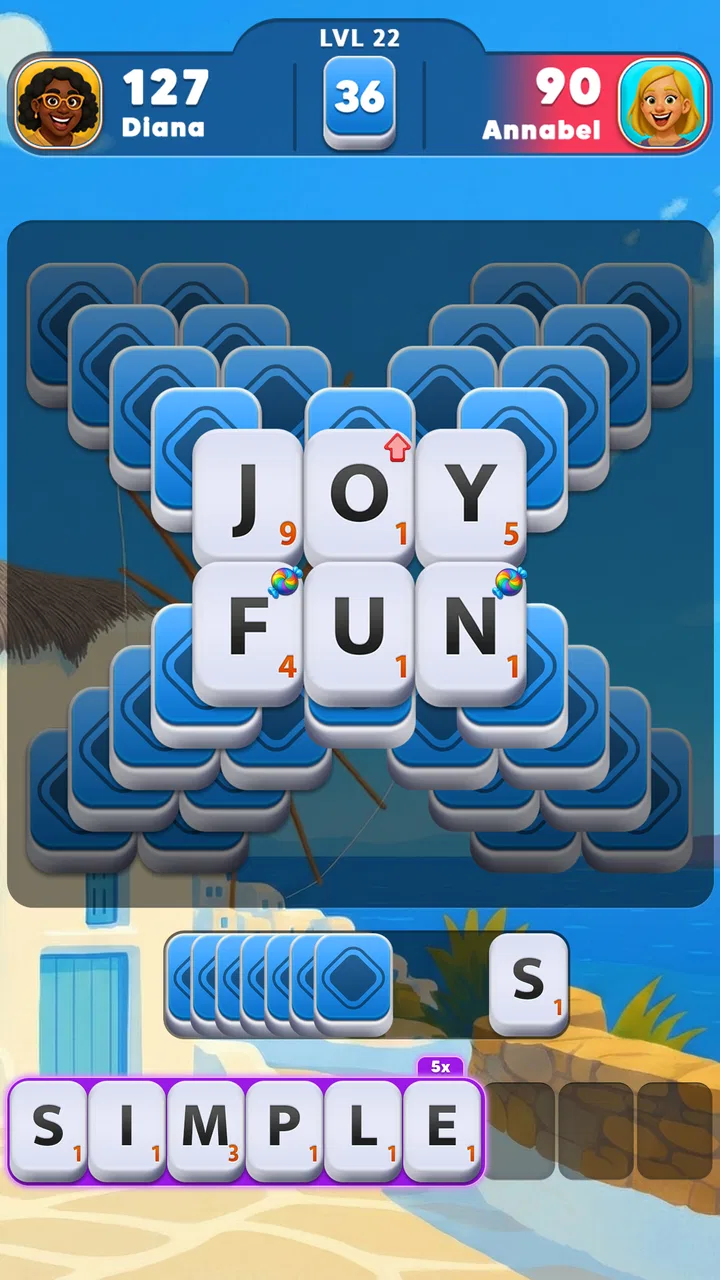
I approached Word Tiles GO as a small, competitive word game rather than something designed to replace a full crossword app. Its appeal is easy to understand: it turns vocabulary into a quick duel, gives me a reason to think under pressure, and keeps the experience focused enough for short sessions. The store summary calls it a brain-boosting word duel, but what matters in practice is whether that format feels comfortable during ordinary moments such as a commute, a short break, or a few minutes before bed.
Developed by Gulliver's Games, this free word game is aimed at Everyone and runs on Android devices using version 7.0 or later. That broad compatibility makes it approachable for people who do not own a recent phone. It has also built a solid audience, with a 4.6 average from around 8.6 thousand ratings and more than 100 thousand installs. Those figures suggest that the basic idea is connecting with players, although popularity alone does not tell me whether the game suits your preferred pace or tolerance for in-app purchases.
How Word Tiles GO feels during quick and demanding sessions
I find the best way to judge a quick word duel is to notice how its pace changes when I’m fresh versus when I’m tired or distracted. A short session can be a pleasant mental reset, while repeated rounds may make each choice feel more demanding. That contrast also helps explain what keeps the game’s central loop moving: the feedback after a word, the satisfaction of a good turn, and the urge to try again.
You May Also Like

 Blood Strike: 2.5 Anniversary
Blood Strike’s Loadouts Turn Every Drop Into a Tactical Gamble
A close look at Blood Strike’s custom loadouts: how fast access to signature weapons reshapes its battle royale rhythm, rewards preparation, and narrows the gap between fights.

 Pandora - Music & Podcasts
Pandora’s Music Is Easy to Start, but Harder to Recover
Pandora’s strength is its low-effort path from a seed to a station. Its weak spot is how much confidence it asks you to place in connection, setup, and quiet recovery.

 8 Ball Pool
 Is Built on Rivalries, Rematches, and Routine
A close look at the rivalries, rematches, shared routines, and unanswered safety questions that turn a quick pool match into a persistent mobile community.

 Samsung Music
’s Quiet Strength Is Playing What You Already Own
Its reach comes less from spectacle than from dependable access to a personal library. That simplicity is both the app’s strongest retention engine and its ceiling.

 AccuWeather: Weather Radar
AccuWeather Review: A Quick, Clear Forecast for Everyday Decisions
For everyday plans, the best forecast is the one you can understand quickly. AccuWeather makes rain timing, radar, and local conditions easy to act on, with a few trade-offs.

 Hill Climb Racing
Why Hill Climb Racing Still Turns Crashes Into One More Run
A tiny car, a bumpy hill and one more upgrade: Hill Climb Racing keeps resurfacing because its simple chaos makes every near-miss feel personal.
More From Our News Desk
View All News


Fast access matters more than flashy presentation
The first thing I look for in a word duel is how quickly I can move from deciding to play to actually making words. This is not the kind of game where I want a long setup or a complicated learning period. The short description, “Word Tiles GO,” sets a simple expectation, and the experience is best understood through that simplicity: open it, focus on letters, and make decisions.
On a suitable device, the format should feel naturally suited to short bursts because word construction does not require a large virtual world, extensive visual exploration, or a long narrative introduction. That gives the game a practical advantage over many larger mobile titles. I can imagine using it when I have only a few minutes and still getting a complete mental challenge instead of abandoning a session halfway through.
That does not mean every player will experience the same sense of speed. A word game can feel slow even when its interface responds promptly if the available letters are awkward, the opponent creates pressure, or I spend too long searching for a better combination. It is useful to separate device responsiveness from thinking time. The former is about the phone and the app; the latter is part of the challenge.
Why the duel format changes the way I play
Compared with a traditional crossword, Word Tiles GO places more emphasis on immediate choices. A crossword usually lets me work at my own rhythm, leave a clue unfinished, and return later with no opponent waiting. A duel creates a different kind of attention. I am not only asking whether a word is valid; I am also weighing whether it is worth acting now or searching for something stronger.
That trade-off makes the game more accessible than a large puzzle book for some players, but less relaxing for others. If I want a quiet vocabulary exercise with no pressure, a conventional crossword or an untimed word search may be a better match. If I enjoy the small tension of having another side to beat, the duel structure gives ordinary letter choices more importance.
What I would do in a typical everyday session
My most realistic use case would be a short waiting period: I have finished a message, still have several minutes before an appointment, and want something more engaging than scrolling. I would start a round, concentrate on the letters, and stop after the duel rather than committing to a long play session. The game’s word-focused design suits that situation because I can give it full attention without needing sound, a large screen, or a complicated story to remember.
There is also a useful habit for players who tend to rush. Instead of immediately accepting the first familiar word, I would scan for common endings and beginnings, then consider whether a less obvious word could produce a better result. This is not a guaranteed strategy, but it turns each round into a vocabulary exercise instead of a reflex test. It also helps reveal whether the game is improving your word instincts or simply rewarding the same familiar patterns.
When heavier use can expose friction
A single short round is an easy test for almost any lightweight word game. The more revealing situation is repeated play: several duels in one sitting, especially when I am switching between rounds quickly or playing while the phone is already busy with other tasks. In those moments, I pay attention to whether the game remains comfortable, whether transitions stay clear, and whether I can return to the activity without losing track of what I was doing.
I would not treat a word game as demanding in the same way as a graphically intensive action title. The main load here is mental rather than visual. Still, repeated sessions can make small interface delays feel more noticeable because the entire appeal depends on a clean exchange between seeing letters, choosing a word, and continuing the duel. Any pause in that rhythm matters more in a focused puzzle than it would in a slower simulation game.
There is another kind of heavy use: playing when the battery is low, several apps are open, or the phone is older. Since the game supports Android 7.0 and later, it is not restricted to modern hardware by its minimum operating-system requirement. However, an operating-system baseline is not a promise that every older phone will feel equally comfortable. Screen quality, available memory, background activity, and the general condition of the device can all affect how pleasant a session feels.
Stability and recovering from interruptions
Reliability matters particularly in a duel because an interruption can feel more damaging than it would in a solo puzzle. A phone call, a notification, or an accidental app switch can break concentration at exactly the wrong moment. When I use a game like this, I want to know that returning to it feels understandable rather than forcing me to reconstruct the entire situation from memory.
The sensible way to approach recovery is to treat each round as a contained activity. I would avoid beginning a serious session when I know I may need to answer messages immediately, and I would keep the app in the foreground during a competitive exchange. That is not a criticism unique to this title; it is a practical adjustment for any game built around quick decisions.
For casual use, this makes the game easier to recommend than a long-form title where an interruption can erase a much larger investment of time. If I lose focus after a few minutes, the cost is limited. For players who want a perfectly uninterrupted competitive environment, though, a dedicated word-game platform with more extensive match controls may be preferable, especially if they regularly play longer sessions.
Resource expectations without overpromising
Word Tiles GO presents itself as a focused word game, so I would expect its main demands to be modest compared with a modern three-dimensional game. That makes it a reasonable candidate for a spare phone or a device used mainly for everyday apps. I would still avoid assuming that “simple” means completely free of resource concerns. Any app can feel less responsive when storage is crowded, the operating system is busy, or many background processes are active.
My practical recommendation is to judge it by the experience on your own phone during a normal session. Open it after closing unusually demanding apps, play several rounds, and see whether the interaction remains comfortable. If it does, there is little reason to worry about theoretical hardware comparisons. If it feels sluggish, the problem may be the age or condition of the device rather than the word format itself, but the result is still relevant to your decision.
How it compares with familiar word-game alternatives
The closest alternatives are not all direct competitors. Crossword apps are better when I want clues, gradual solving, and a personal pace. Word searches are more suitable when I want visual scanning without the same strategic pressure. Board-style word games can offer deeper planning and a larger sense of progression, but they may also require more time and patience before a session feels complete.
Word Tiles GO sits in the middle: more active than a passive vocabulary exercise, but less demanding in commitment than a large strategy game. Its strongest use is as a compact challenge that asks me to think quickly. Its weaker use is as a calm, long-form puzzle companion. If you dislike timed-feeling decisions or become frustrated when the best word does not appear immediately, the duel format may feel stressful rather than motivating.
Players should also consider the cost structure before settling in. The game is free to download and play, but it includes in-app purchases ranging from $0.99 to $99.99 per item. That range is important because “free” describes the entry point, not necessarily every possible way of using the game. I would begin without spending anything, learn how the normal experience feels, and only consider a purchase if it solves a specific annoyance rather than being an impulsive response to a difficult round.
Practical advice for keeping the experience comfortable
My first tip is to use short sessions deliberately. The game’s word-duel identity works best when I approach it as a focused break, not as something that must occupy an entire evening. Stopping after a few rounds can preserve the enjoyable tension and reduce the chance that repeated losses turn the activity into a chore.
My second tip is to separate vocabulary practice from winning. I would notice unfamiliar words, remember useful letter combinations, and treat difficult turns as clues about how I search. That mindset makes the game more valuable for learners and casual players who may not have an extensive vocabulary yet. It also prevents one disappointing result from defining the whole session.
A third useful adjustment is to test the game under the conditions in which you actually plan to use it. If you want to play on an older Android phone during commutes, try it with your usual battery level and background apps rather than judging it only in ideal conditions. If you plan to play competitively, test whether interruptions are likely to interfere. This small trial tells you more than a general promise about speed.
Finally, I would keep an eye on spending boundaries. Because individual purchases can reach a high amount relative to a free word game, I would not treat optional items as necessary for enjoying the core idea. Decide in advance whether you are comfortable paying, and avoid using purchases to chase a better result after a frustrating duel. The best value comes from the challenge itself, not from trying to buy your way past every difficult moment.
Who should try it, and who should skip it
I would recommend it to people who enjoy vocabulary games but want more urgency than a standard crossword provides. It is also a good fit for someone looking for a compact mental break, a family-friendly game with an Everyone content rating, or a word challenge that can be tested without an upfront purchase. The broad Android support is helpful for users with devices that are not running the newest software.
I would be more cautious about recommending it to players who want a deep solo puzzle archive, a story, or a highly elaborate competitive system. Crossword enthusiasts may miss clue-based solving, while board-game fans may find a short word duel less strategically rich than a full tabletop-style experience. Anyone uncomfortable with optional purchases should also review the payment approach carefully before making the game part of a daily routine.
My performance verdict
Word Tiles GO works best when I judge it by its intended scale. It is not trying to be a massive mobile production; it is a focused word game built around quick mental decisions. That makes its perceived speed depend less on visual spectacle and more on whether the exchange between letters and choices feels immediate on your device. On compatible hardware, its modest concept should make it a sensible candidate for short sessions, while older or busy phones deserve a personal trial rather than an assumption.
Its reliability value is similarly practical. A compact duel is easier to resume than a long campaign, but interruptions can still affect a competitive round, so I would play when I can give it a few uninterrupted minutes. The free entry point lowers the barrier to testing it, and the 4.6 average shows that many players respond positively, while the in-app purchase range is a reason to keep spending intentional.
Released on May 24, 2025, and currently listed as version 1.6.35, the game has a clear identity: quick word competition with a low commitment threshold. I would install it if I wanted a lightweight vocabulary challenge that feels more active than a crossword and less demanding than a large strategy game. I would skip it if my priority were a completely pressure-free puzzle or a rich solo word library.
My final view is favorable but measured. Word Tiles GO is strongest as a reliable little mental break, not as an all-purpose word-game replacement. Try it free, test several rounds on your own phone, and decide whether the duel rhythm makes you curious or tense. If you enjoy finding words under pressure, it can earn a regular place in your short-break routine; if you prefer to solve at your own pace, one of the traditional alternatives will probably serve you better.
FAQs for Word Tiles GO
01What is Word Tiles GO and how does it work?
Word Tiles GO is a word puzzle game that challenges players to form words from a grid of letters. The objective is to create as many words as possible within a set time limit or with a limited number of moves. The game features multiple levels of difficulty and offers various power-ups to assist players in advancing through tougher stages.
02Is Word Tiles GO available for both Android and iOS?
Yes, Word Tiles GO is available for download on both Android and iOS platforms. You can find it on the Google Play Store for Android devices and the Apple App Store for iOS devices. The game is free to download, though it may offer in-app purchases for additional features or ad-free experiences.
03Are there any social features in Word Tiles GO?
Word Tiles GO includes several social features that enhance the gaming experience. Players can connect with friends through social media, participate in leaderboards, and engage in weekly challenges. These features allow players to compete with others, track their progress, and share achievements, making the game both interactive and competitive.
04Does Word Tiles GO require an internet connection to play?
While Word Tiles GO offers offline gameplay for its single-player mode, certain features like social interactions, leaderboards, and daily challenges require an internet connection. To fully enjoy all aspects of the game, it is recommended to have a stable internet connection, especially when participating in online competitions or updates.
05What are the in-app purchases available in Word Tiles GO?
Word Tiles GO offers a variety of in-app purchases to enhance gameplay. These include power-ups, extra lives, and ad-free options. Players can also purchase additional levels or exclusive content. While the game is free to play, these optional purchases can provide a more tailored and uninterrupted gaming experience.
Pros
- Engaging word puzzle challenges.
- Simple and intuitive UI design.
- Offline play available.
- Regular updates with new levels.
- Boosts vocabulary and spelling.
Cons
- Ads can be intrusive.
- Limited daily challenges.
- In-app purchases can be costly.
- Requires internet for some features.
- Occasional lag on older devices.

Word Tiles GO
Gallery